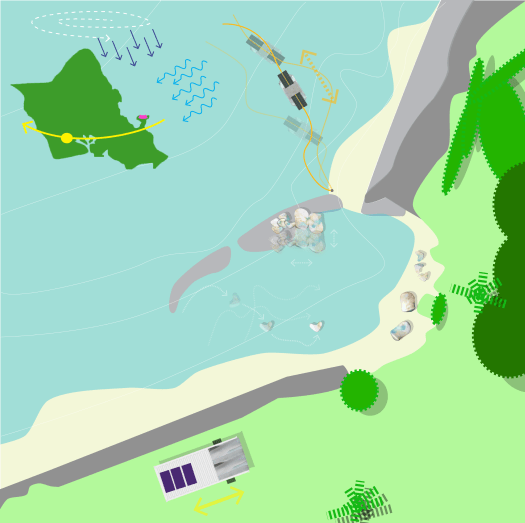
master plan/site analysis

MASTERFINAL3

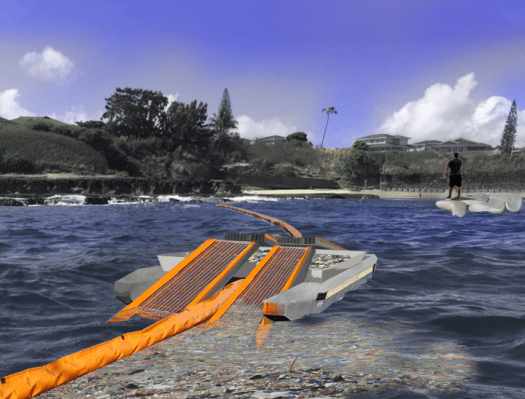
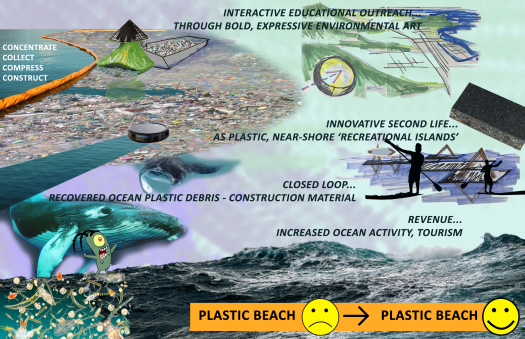
The collection process is well-suited for small coastal bays where the boom can concentrate debris away from shallow-water activity (so as to not impact the beach-going experience). The wind and wave action may limit the collection equipment, and operators will have to monitor the conditions. Much of these influences are seasonal and predictable (e.g. north swells on the north shore during the winter would inhibit operation). The production process is mobile, self-contained, and self-supporting.  Two operators transport and operate the system to produce the WEBEs. The WEBEs may be placed on the beach or in the water.  Their use will be site-specific and dependent on conditions and user desires.

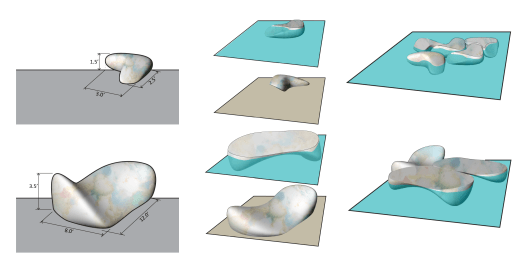
The specific site detailed in this design is North Beach Kailua, HI, which is on the north side of the Mokapu peninsula aboard Marine Corps Base Hawaii.  The beach faces north and offers beach-goers both sandy and rocky beach and shallows, which support a broad range of activities. The Collector is anchored to the rocky shoreline to the east; ghosted images show how the skimmer moves along the boom and how the collection operation is affected by environmental influences. The Producer is situated in a small grassy field between two beach accesses.  Here there is room to relocate and operate the system; this location is visible reinforcing the interactive educational outreach component of the project.  Beach-goers would even be encouraged to drop off any plastic debris they may gather on the beach.  Finally, this image shows WEBEs placed on the beach and near shore.  Ghosted images indicate how a Small WEBE would interact with tides, wind, and waves and how groups of Small and Large WEBEs tethered together and anchored to the ocean floor would interact with the tides.  The influence of these forces is also visible in the below pictures representing daily (diurnal) tides, seasonal sand fluctuations, and seasonal/daily wave/wind variation.

These images also explore the possibilities for installation/use: WEBE Groups, Freely Distributed WEBEs, and WEBE Clusters.
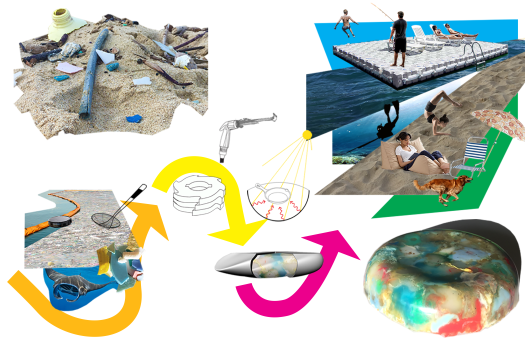
 

updated concept collage

CONCEPTFINALWaste Enhanced Beach Experience (WEBE)

Three phases:

  • Collection: concentrate/collect
  • Production: shred/rinse/melt/mold
  • Enhancement: beach/nearshore

SLEDCOLLECTORCOLLECTION

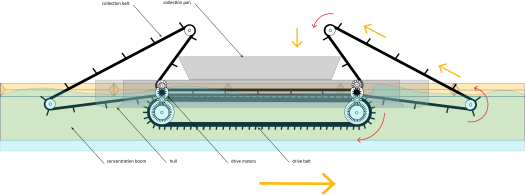
Concentrate. A mobile boom anchored to the shore oriented toward dominant debris-directing influences concentrates debris to optimize collection. Collect. A mobile skimmer ‘rides’ the boom and can collect debris on either side while moving mauka or makai (solar electric).

PRODUCER

PRODUCTION

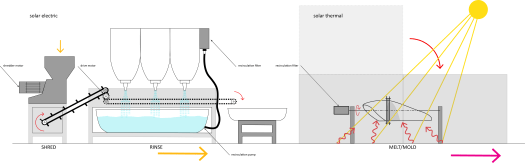
Shred. Collected debris is shredded further; the shredder can also accept material gathered by beach-goers. Rinse. Rinsing removes salt and unwanted contaminants; water is recirculated and filtered (solar electric). Melt/Mold.  Melting/molding take place in a parabolic solar oven (solar thermal). The production system is containerized and can be transported to support many sites as the debris accumulates at different collection systems.

TECHNICAL DRAWINGS

ENHANCEMENT

Waste Enhanced Beach Experience (WEBEs) are rigid plastic shapes that can enhance the beach-going experience in both the beach and nearshore environments. The devices may be employed in a formal way managed by water safety personnel or beach management (resort), or they may be employed freely, allowed to meander with the environmental influences and/or users’ desires (free/multi-use programing).

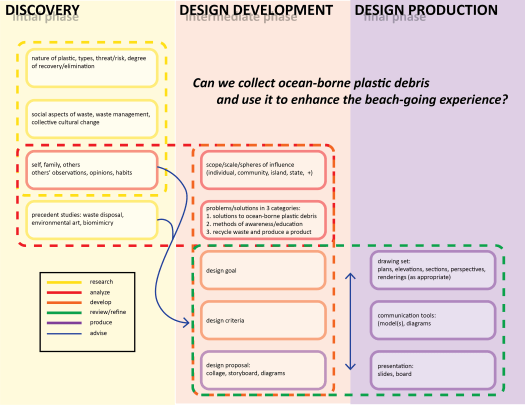
methodology

DESIGN METHODOLOGY.png

Key conclusions from the Discovery phase:

  • Plastic is used for many purposes; some noble, some ignoble
  • Ocean-borne plastic debris may be collected before it washes up on the beaches
  • Mixed plastics (different recycling categories) can be recycled together
  • “Disposable consumerism” is a large component of our collective culture
  • To limit ocean-borne (and beach) plastic debris, collection/recycling efforts must be combined with education to “turn off the faucet” of plastics entering our waste streams

Refined Research Question:

Can we collect plastic ocean debris before it arrives on our beaches and use it to develop products that will enhance the beach-going experience?

Design Goals:

  1. Collect plastic debris in the open ocean or nearshore environment
  2. Recycle the ocean-borne, mixed plastic debris; produce building materials
  3. Assemble nearshore or beach-based ‘playground equipment’
  4. Enhance the beach-going experience

Design Criteria:

System scale

  1. Achieve net-zero energy
  2. Minimize human input/operation (autonomous)
  3. Minimize impact to open ocean/nearshore life
  4. Mitigate rough seas (withstand/hunker down/redeploy)
  5. Collect floating debris
  6. Process debris
  7. Melt/compress mixed plastic – produce building materials

Product scale (object-scale/human experience scale)

  1. Remain stationary or minimally mobile (beach (B)); react to tide, wave, wind influence (nearshore (NS))
  2. Resist elements; do not flake or degrade
  3. Tread lightly; avoid extensive ‘foundations’ and additional building material/support
  4. Enhance beach-going experience; concepts listed below (perhaps more than one form from common building blocks):
  5. Shade from direct sunlight B/NS
  6. Screen wind B
  7. Keep towels, clothes, etc. dry B
  8. Provide dog tie out B
  9. Provide fishing rod holders B/NS
  10. Transport beach equipment (food, towels, clothes, balls, sunblock, etc.) B
  11. Provide seating/lounging options/support B/NS
  12. Unprogrammed use – jumping off, climbing, sitting, laying (bench and play structure at once) B/NS
  13. Support fishing, snorkeling, diving NS
  14. Support water activities – nearshore staging area for snacks, water, sunscreen, equipment (similar to floating ski lodge) NS
  15. Provide access to deeper water NS
  16. Cordon deeper water, jellyfish, man-o-war, fragile nearshore sea life (create, highlight, protect ‘shallow pool’) NS


precedents